
เดอร์มาโทพอนตินจากหอยเป๋าฮื้อและเปปไทด์ที่มีลำดับ RFK ช่วยส่งเสริมการสร้างกระดูกผ่านวิถีการส่งสัญญาณ TGF-β/Smad
Highlight
Bone formation requires precursor cells to develop into bone-forming cells and to build an organized surrounding structure rich in collagen. This study examined dermatopontin (DPT) from the marine mollusk Haliotis diversicolor and a short peptide containing the RFK sequence, which may help activate signals involved in bone formation. In experiments using pre-osteoblast cells, neither DPT nor the RFK peptide was toxic to the cells, and both increased the activity of genes linked to bone-forming cell development. DPT also increased collagen production and deposition, as well as mineral buildup in the surrounding matrix—an important step in bone formation. The findings suggest that DPT may work through the TGF-β/Smad signaling pathway. These results identify abalone-derived DPT and the RFK peptide as promising candidates for further research into bone regeneration.
การสร้างกระดูกต้องอาศัยทั้งการพัฒนาเซลล์ให้กลายเป็นเซลล์สร้างกระดูกและการจัดระเบียบของโครงสร้างรอบเซลล์ ซึ่งมีคอลลาเจนเป็นองค์ประกอบสำคัญ งานวิจัยนี้ศึกษาเดอร์มาโทพอนทิน (DPT) จากหอยเป๋าฮื้อชนิด Haliotis diversicolor และเปปไทด์สายสั้นที่มีส่วน RFK ซึ่งเป็นลำดับกรดอะมิโนที่อาจช่วยกระตุ้นสัญญาณที่เกี่ยวข้องกับการสร้างกระดูก ผลการทดลองในเซลล์ตั้งต้นของเซลล์สร้างกระดูกพบว่า ทั้ง DPT และเปปไทด์ RFK ไม่เป็นพิษต่อเซลล์ และช่วยเพิ่มการทำงานของยีนที่เกี่ยวข้องกับการพัฒนาเซลล์สร้างกระดูก นอกจากนี้ DPT ยังช่วยเพิ่มการสร้างและการสะสมคอลลาเจน รวมทั้งการสะสมแร่ธาตุในโครงสร้างรอบเซลล์ ซึ่งเป็นขั้นตอนสำคัญของการสร้างกระดูก ผลการทดลองยังชี้ว่า DPT อาจออกฤทธิ์ผ่านเส้นทางสัญญาณ TGF-β/Smad งานวิจัยนี้จึงเสนอว่า DPT จากหอยเป๋าฮื้อและเปปไทด์ RFK อาจเป็นสารชีวภาพที่มีศักยภาพสำหรับการศึกษาต่อยอดด้านการฟื้นฟูกระดูก
ที่มาและความสำคัญ
การสร้างกระดูกและการสร้างเปลือกหอยมีความคล้ายคลึงกัน หากเราสามารถนำโปรตีน dermatopontin ที่ได้จากหอยเป๋าฮื้อนำมาศึกษาผลของโปรตีนและเปปไทด์เฉพาะส่วน RFK มีผลต่อการเหนี่ยวนำการสร้างกระดูกของเซลล์ preosteoblast ซึ่งสามารถนำไปพัฒนาเพื่อเป็นสารกระตุ้นการสร้างกระดูกได้ในทางคลินิก
Abstract
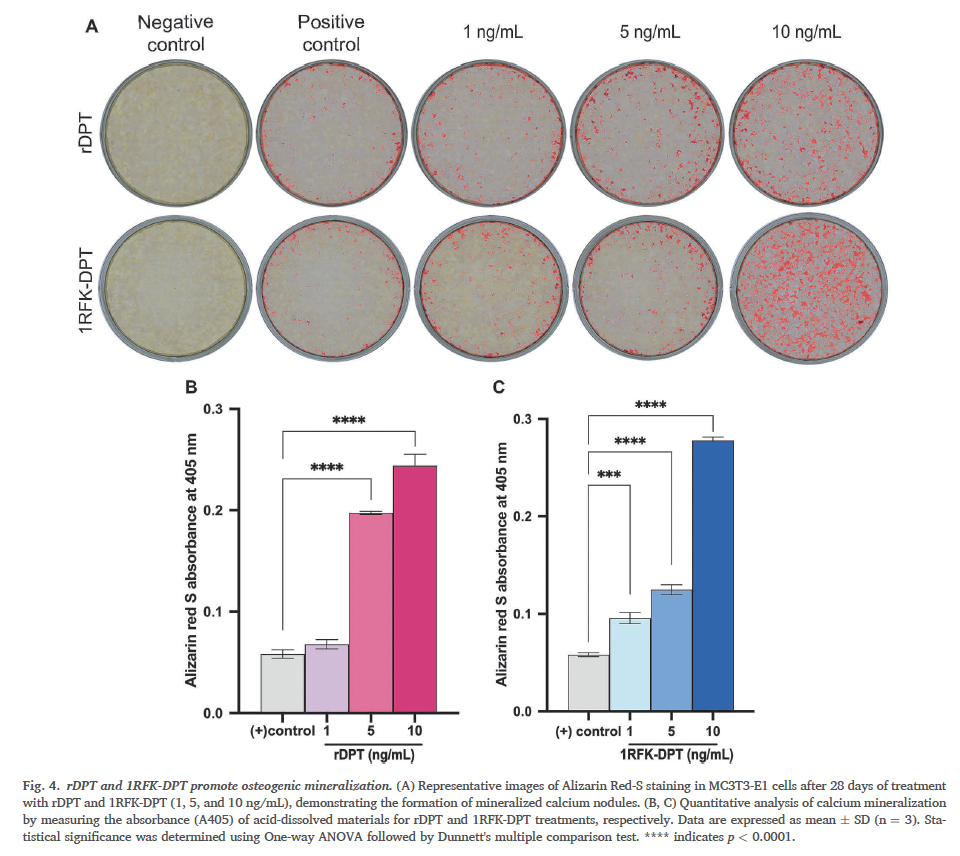
Bone regeneration depends on the coordinated interplay of cellular differentiation and extracellular matrix (ECM) organization. Dermatopontin (DPT), a non-collagenous ECM protein, is essential for collagen fibrillogenesis and cell-matrix interactions, particularly during wound healing. Bioinformatic analysis of DPT from the marine mollusk Haliotis diversicolor reveals a conserved RFK motif known to activate TGF-β signaling, suggesting that it may also be involved in osteogenesis, a process that requires collagen deposition in the ECM. This study examined the osteogenic potential of recombinant DPT (rDPT) and a synthetic short peptide containing the RFK motif (1RFK-DPT) in MC3T3-E1 pre-osteoblasts. Both rDPT and 1RFK-DPT demonstrated non-cytotoxicity in MC3T3-E1 cells and upregulated the expression of key osteogenic marker genes, including RUNX2, OSX, ALP, OPN, COL1A1, and OCN. Translationally, rDPT increased COL1A1 protein expression and its deposition, as demonstrated by Western blotting and immunofluorescence analysis, as well as enhanced ECM mineralization, as shown by Alizarin Red S staining. In silico molecular docking supported a potential interaction between the RFK motif and the latent TGF-β complex. Additionally, rDPT rapidly induced Smad2 phosphorylation within 15 min of treatment, which was effectively blocked by SB-431542, a specific inhibitor of the TGF-β type I receptor (ALK5), indicating that DPT acts through the canonical TGF-β/Smad signaling pathway. In summary, both full-length rDPT and 1RFK-DPT peptides enhance osteogenesis by promoting osteoblast differentiation and matrix mineralization via TGF-β/Smad signaling activation. These results expand the list of marine-derived bioactive compounds with a potential for bone regenerative medicine.
KEYWORDS: Dermatopontin, Peptide, Osteoinduction, Biomineralization, TGF-β/Smad signaling, Bone tissue engineering
Citation: Purimpuch Soongnart, Supawich Boonkua, Orawan Thongsum, Rueangtip Chantunmapitak, Primwadee Wichienwat, Pan Soonsawad, Wattana Weerachatyanukul, Aungkura Supokawej, Somluk Asuvapongpatana. Abalone-derived dermatopontin and its RFK-containing peptide promote osteogenesis via TGF-β/Smad signaling pathway. International Journal of Biological Macromolecules 2026, 376:153562. https://doi.org/10.1016/j.ijbiomac.2026.153562
RELATED SDGs:
3. GOOD HEALTH AND WELL-BEING

ผู้ให้ข้อมูล: รองศาสตราจารย์ ดร.สมลักษณ์ อสุวพงษ์พัฒนา
ชื่ออาจารย์ที่ทำวิจัย: รองศาสตราจารย์ ดร.สมลักษณ์ อสุวพงษ์พัฒนา รองศาสตราจารย์ ดร.วัฒนา วีรชาติยานุกูล
แหล่งทุนวิจัย: Mahidol University (Fundamental Fund: fiscal year 2025 by National Science Research and Innovation Fund (NSRF))
Credit ภาพถ่าย: รองศาสตราจารย์ ดร.สมลักษณ์ อสุวพงษ์พัฒนา รองศาสตราจารย์ ดร.วัฒนา วีรชาติยานุกูล
ชื่อนักศึกษาที่ทำวิจัย: Purimpuch Soongnart, Supawich Boonkua, Orawan Thongsum, Rueangtip Chantunmapitak
Webmaster: ว่าที่ ร.อ. นเรศ จันทรังสิกุล
Tags: Dermatopontin, Peptide, Osteoinduction, Biomineralization, TGF-β/Smad signaling, Bone tissue engineering