
บทบาทในการปกป้องระบบประสาทของสารสกัดจากปลิงทะเล Holothuria leucospilota ต่อความเป็นพิษจากอะไมลอยด์-เบตา ผ่านกลไกออโตฟาจีและการต้านอนุมูลอิสระในแบบจำลอง Caenorhabditis elegans
Highlight
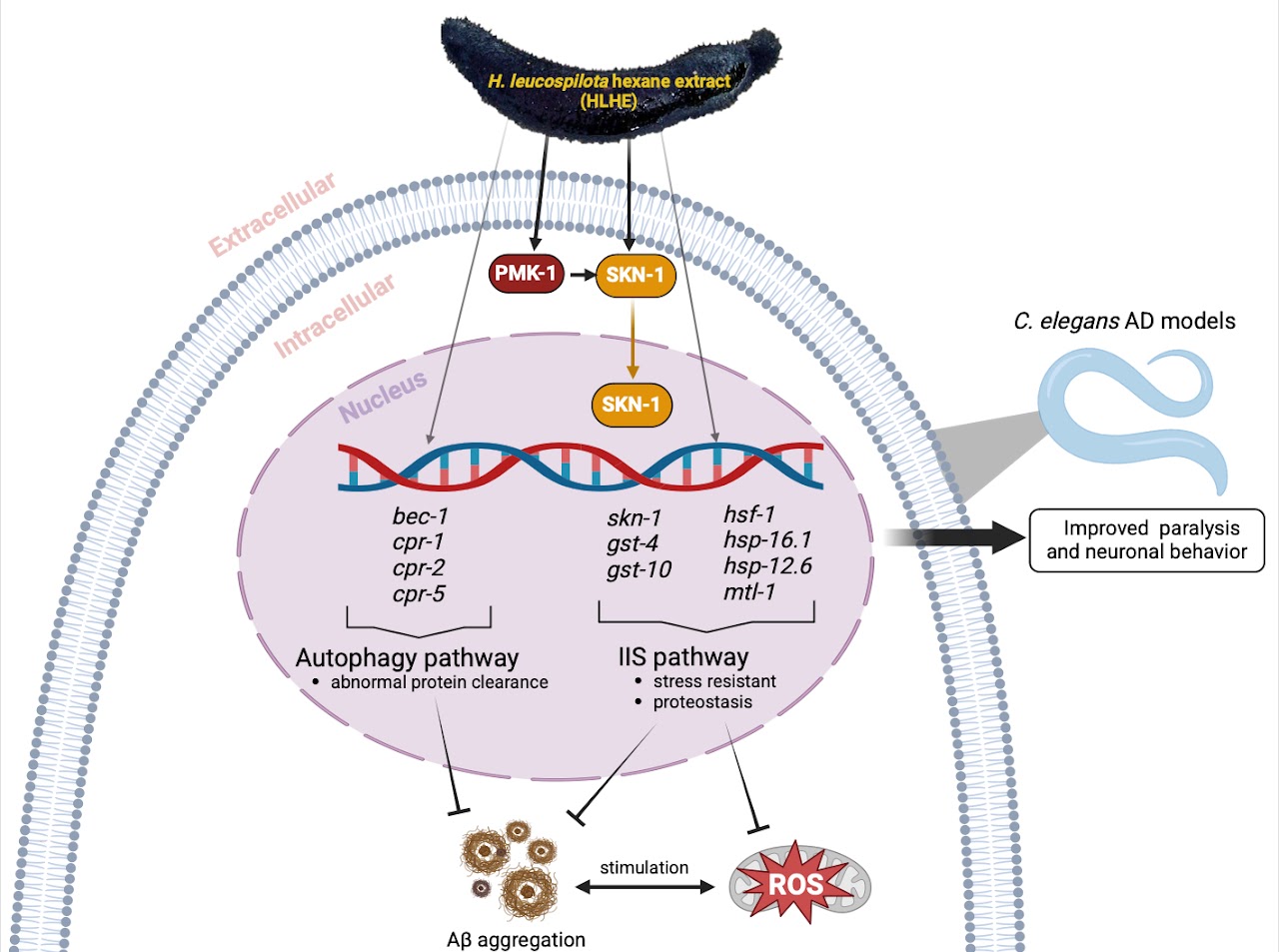
งานวิจัยนี้แสดงให้เห็นว่าสารสกัดเฮกเซนจากปลิงทะเลดำ Holothuria leucospilota ช่วยชะลออาการอัมพาตและปรับปรุงพฤติกรรมการเคลื่อนที่เข้าหาสารดึงดูดในหนอนตัวกลมแบบจำลองโรคอัลไซเมอร์ พร้อมลดการสะสมของอะไมลอยด์-เบตาและอนุมูลอิสระ โดยเกี่ยวข้องกับการกระตุ้นออโตฟาจีและระบบป้องกันความเครียดออกซิเดชัน ผลการศึกษาสนับสนุนศักยภาพของสารสกัดจากปลิงทะเลในการศึกษาต่อยอดเพื่อป้องกันความเสื่อมของระบบประสาท
ที่มาและความสำคัญ
โรคอัลไซเมอร์ (Alzheimer’s disease) เป็นโรคความเสื่อมของระบบประสาทที่ส่งผลให้ความสามารถด้านความจำและการรู้คิดลดลง โดยมีปัจจัยสำคัญที่เกี่ยวข้อง ได้แก่ การสะสมของโปรตีนอะไมลอยด์-เบตา (amyloid-β; Aβ) และความเครียดออกซิเดชัน ซึ่งส่งผลกระทบต่อการทำงานและความอยู่รอดของเซลล์ประสาท ดังนั้น การค้นหาสารออกฤทธิ์ทางชีวภาพจากแหล่งธรรมชาติที่สามารถช่วยควบคุมการสะสมของ Aβ และส่งเสริมกลไกป้องกันความเสียหายของเซลล์ จึงเป็นแนวทางที่น่าสนใจสำหรับการศึกษาวิจัยโรคความเสื่อมของระบบประสาท ซึ่งปลิงทะเล Holothuria leucospilota เป็นทรัพยากรทางทะเลที่มีองค์ประกอบทางชีวภาพหลากหลาย และอาจเป็นแหล่งของสารที่มีศักยภาพในการส่งเสริมสุขภาพ อย่างไรก็ตาม บทบาทของสารสกัดจากปลิงทะเลชนิดนี้ต่อความเป็นพิษที่เกิดจาก Aβ และกลไกระดับโมเลกุลที่เกี่ยวข้องยังจำเป็นต้องได้รับการศึกษาเพิ่มเติม งานวิจัยนี้จึงมุ่งประเมินฤทธิ์ปกป้องระบบประสาทของสารสกัดเฮกเซนจาก H. leucospilota (HLHE) โดยใช้หนอนตัวกลม Caenorhabditis elegans ที่ดัดแปลงพันธุกรรมเป็นแบบจำลองโรคอัลไซเมอร์ พร้อมประเมินผลต่อการเกิดอัมพาต พฤติกรรมการเคลื่อนที่เข้าหาสารดึงดูด การสะสมของ Aβ ระดับอนุมูลอิสระ และการแสดงออกของยีนที่เกี่ยวข้องกับออโตฟาจีและระบบป้องกันความเครียดออกซิเดชัน ผลการศึกษาจึงช่วยเพิ่มความเข้าใจเกี่ยวกับศักยภาพของสารสกัดจากปลิงทะเลในการลดความเป็นพิษจาก Aβ และเป็นพื้นฐานสำหรับการศึกษาต่อยอดในแบบจำลองที่ซับซ้อนขึ้น
Abstract
Alzheimer’s disease (AD) is a major global health challenge characterized by cognitive decline and neuronal degeneration driven by amyloid-β (Aβ) aggregation and oxidative stress. Given the limited efficacy and adverse effects of current pharmacological therapies, food-derived bioactive compounds have gained increasing attention as potential preventive strategies against neurodegenerative disorders. In this study, we investigated the neuroprotective effects of Holothuria leucospilota extracts using a transgenic Caenorhabditis elegans model of AD. Our results demonstrated that H. leucospilota hexane extract (HLHE) at 500 µg/mL significantly delayed Aβ-induced paralysis and improved chemotaxis behavior. Consistently, HLHE treatment reduced Aβ deposition and decreased both high- and low-molecular weights of Aβ oligomers, as determined by automated Western blot analysis. Additionally, HLHE also reduced reactive oxygen species (ROS) levels. Transcriptomic and RT-qPCR analyses revealed that HLHE enhanced autophagic activity through the upregulation of bec-1 (autophagy initiation) and lysosomal genes (cpr-1, cpr-2, and cpr-5). Furthermore, HLHE activated antioxidant defense pathways via the insulin/IGF-1 signaling (IIS) axis, specifically upregulating genes associated with SKN-1 pathway (pmk-1, skn-1, gst-4, and gst-10) and HSF-1 pathway (hsf-1, hsp-16.1, hsp-12.6, and mtl-1). HLHE also promoted nuclear localization of SKN-1 and increased expression of its downstream target gst-4. Chemical analysis revealed that HLHE contained arachidonic acid (21.12%) and other bioactive lipid compounds as major constituents, suggesting a synergistic role in promoting autophagy and antioxidant responses. Collectively, this study suggests that HLHE confers neuroprotection against Aβ-induced toxicity by activating autophagy and oxidative stress defense mechanisms, supporting its potential development as a food-derived preventive or therapeutic agent for AD.
KEYWORDS: Alzheimer’s disease; amyloid-β; autophagy; Caenorhabditis elegans; Holothuria leucospilota
Citation: Kamonnat C, Thongdechsri S, Kraokaew P, Niamnont N, Sobhon P, Meemon K*. Protective Role of Holothuria leucospilota Extract Against Amyloid-β Toxicity via Autophagy and Antioxidant Mechanisms in Caenorhabditis elegans Model. Oxid Med Cell Longev. 2026;2026(1):e1471919. doi: 10.1155/omcl/1471919.
RELATED SDGs:
3. GOOD HEALTH AND WELL-BEING

14. LIFE BELOW WATER
ผู้ให้ข้อมูล: รองศาสตราจารย์ ดร.ไกร มีมล
ชื่ออาจารย์ที่ทำวิจัย: รองศาสตราจารย์ ดร.ไกร มีมล
แหล่งทุนวิจัย: National Research Council of Thailand (NRCT) and Mahidol University
Credit ภาพถ่าย: รองศาสตราจารย์ ดร.ไกร มีมล
ชื่อนักศึกษาที่ทำวิจัย: Chanathip Kamonnat, Salinthip Thongdechsri
Webmaster: ว่าที่ ร.อ. นเรศ จันทรังสิกุล
Tags: Alzheimer’s disease, amyloid-β, autophagy, Caenorhabditis elegans, Holothuria leucospilota