
ปฏิสัมพันธ์ระหว่างไวรัสก่อโรคแคระแกร็น (IHHNV) กับเนื้อเยื่อของกุ้งขาวแวนนาไม (Penaeus vannamei) โดยมีไกลแคน (โมเลกุลน้ำตาล) เป็นตัวกลาง
Highlight
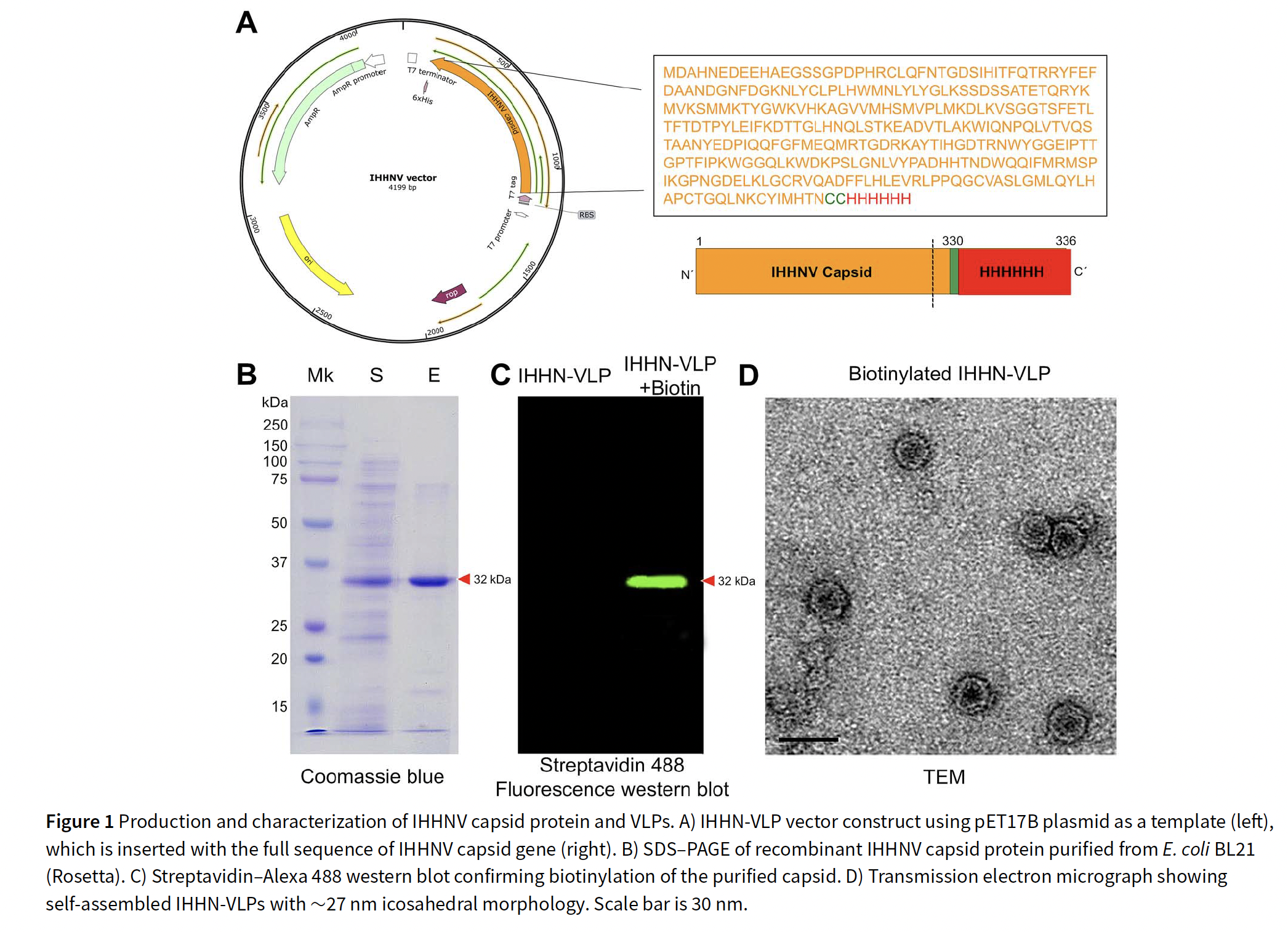
ไวรัส IHHNV เป็นเชื้อที่สร้างความเสียหายต่อการเพาะเลี้ยงกุ้ง โดยเฉพาะกุ้งขาว ซึ่งอาจเกิดกลุ่มอาการตัวแคระแกร็นและเจริญเติบโตผิดปกติ แม้ไวรัสนี้จะมีความสำคัญต่ออุตสาหกรรมกุ้ง แต่กลไกที่ไวรัสใช้จดจำและยึดเกาะกับเนื้อเยื่อของกุ้งยังไม่ชัดเจน งานวิจัยนี้ศึกษาว่าโมเลกุลน้ำตาลบนเนื้อเยื่อกุ้งมีส่วนเกี่ยวข้องกับการจับของไวรัสหรือไม่ โดยใช้อนุภาคคล้ายไวรัส IHHNV ซึ่งมีรูปร่างคล้ายไวรัสแต่ไม่มีสารพันธุกรรมที่ทำให้เกิดการติดเชื้อ ผลการทดลองพบว่าอนุภาคดังกล่าวจับกับเนื้อเยื่อเหงือกและกล้ามเนื้อได้มากกว่าตับและตับอ่อน นักวิจัยยังตรวจพบว่าเนื้อเยื่อเหล่านี้มีโมเลกุลน้ำตาลหลายชนิด รวมถึงน้ำตาลที่มีแมนโนสและฟิวโคส เมื่อใช้สารที่ยับยั้งหรือเปลี่ยนแปลงน้ำตาลเหล่านี้ การจับของอนุภาคคล้ายไวรัสลดลง ผลจึงชี้ว่าน้ำตาลที่มีแมนโนสและฟิวโคสอาจเป็นจุดสำคัญที่ช่วยให้ไวรัสยึดเกาะกับเนื้อเยื่อกุ้ง การค้นพบนี้ช่วยเพิ่มความเข้าใจเกี่ยวกับขั้นตอนเริ่มต้นของการติดเชื้อ IHHNV และอาจนำไปสู่การพัฒนาวิธีป้องกันที่ขัดขวางการจับดังกล่าว อย่างไรก็ตาม ยังจำเป็นต้องศึกษาเพิ่มเติมเพื่อยืนยันบทบาทของน้ำตาลเหล่านี้ในการติดเชื้อจริงในกุ้ง
ที่มาและความสำคัญ
โรคติดเชื้อ IHHNV เป็นปัญหาสำคัญของการเพาะเลี้ยงกุ้งทั่วโลก โดยเฉพาะกุ้งขาว Penaeus vannamei ซึ่งอาจเกิดกลุ่มอาการตัวแคระแกร็นและสร้างความเสียหายทางเศรษฐกิจ
อย่างไรก็ตาม กลไกที่ไวรัสใช้จดจำและเข้าสู่เนื้อเยื่อของกุ้งยังไม่เป็นที่เข้าใจชัดเจน
การศึกษานี้จึงมุ่งตรวจสอบบทบาทของน้ำตาลบนผิวเซลล์ โดยพบว่าน้ำตาลชนิดที่มีแมนโนสและฟิวโคสเกี่ยวข้องกับการจับของไวรัสในเนื้อเยื่อ ผลการศึกษาช่วยเพิ่มความเข้าใจเกี่ยวกับการติดเชื้อ IHHNV และอาจเป็นแนวทางพัฒนาสารยับยั้งที่อาศัยน้ำตาลเพื่อป้องกันการระบาดในอนาคต
Abstract
Infectious hypodermal and hematopoietic necrosis virus (IHHNV) poses a significant threat to global shrimp aquaculture, causing substantial economic losses due to Runt Deformity Syndrome (RDS) in susceptible species, particularly Penaeus vannamei. Despite its widespread impact, the molecular mechanisms underlying IHHNV’s tissue tropism and host entry remain poorly understood. This study investigated the role of host glycans in mediating IHHNV attachment and infection, focusing on the interaction between virus-like particles (VLPs) of IHHNV and glycan profiles in P. vannamei tissues. Using recombinant IHHN-VLPs, we demonstrated preferential binding to muscle and gill tissues, with significantly higher affinity compared to the hepatopancreas. Lectin-based assays and mass spectrometry revealed that these tissues were enriched in oligomannosylated N-glycans substituted or not with fucose, terminal N-acetylglucosamine (GlcNAc) and sulfate groups, as well as complex O-glycans showing very unusual structural features such as substituted fucose residues and terminal N-acetylgalactosamine residues. Inhibition assays by ELISA, Western blot and histochemistry on shrimp’s tissues modified with lectins (ConA, WGA, AAL) and glycosidases (PNGase-F, mannosidase, fucosidase) demonstrated that mannosylated and fucosylated glycans were essential for IHHNV recognition. These findings highlight the importance of glycan-mediated interactions in IHHNV infection, suggesting that mannosylated N-glycans and fucosylated O-glycans serve as primary attachment factors. The conservation of these glycan motifs across crustacean species implies their potential as broad-spectrum viral targets. This study not only advances our understanding of IHHNV pathogenesis but also opens avenues for developing glycan-based antiviral strategies, such as competitive inhibitors or targeted glycosidase treatments, to mitigate viral outbreaks in shrimp aquaculture.
KEYWORDS: arthropoda, ligands, O-glycan, virus
Citation: Sombutkayasith C, Watthammawut A, Thongsum O, Delafontaine J, Boonkua S, Somrit M, Hirayama H, Asuvapongpatana S, Delannoy C, Bompard C, Yu SY, Rossez Y, Weerachatyanukul W, Guerardel Y. (2026). Glycan-mediated interactions of infectious hypodermal and hematopoietic necrosis virus (IHHNV) with host tissues in Pacific whiteleg shrimp (Penaeus vannamei). Glycobiology, 36(12), cwag085. https://doi.org/10.1093/glycob/cwag085
RELATED SDGs:
14. LIFE BELOW WATER
ผู้ให้ข้อมูล: รองศาสตราจารย์ ดร.สมลักษณ์ อสุวพงษ์พัฒนา
ชื่ออาจารย์ที่ทำวิจัย: รองศาสตราจารย์ ดร.วัฒนา วีรชาติยานุกูล รองศาสตราจารย์ ดร.สมลักษณ์ อสุวพงษ์พัฒนา ผู้ช่วยศาสตราจารย์ ดร.มนสิชา สมฤทธิ์
แหล่งทุนวิจัย: CNRS through INTERNATIONAL CALL 2023 “MARINE BIOLOGY,” by Campus France, Franco-Thai Scholarship, and Mahidol University and Thailand Research Fund (TRF) for New Scholars awarded to AW
Credit ภาพถ่าย: รองศาสตราจารย์ ดร.วัฒนา วีรชาติยานุกูล รองศาสตราจารย์ ดร.สมลักษณ์ อสุวพงษ์พัฒนา รองศาสตราจารย์ ดร.วัฒนา วีรชาติยานุกูล ผู้ช่วยศาสตราจารย์ ดร.มนสิชา สมฤทธิ์
ชื่อนักศึกษาที่ทำวิจัย: ชัญญารักษ์ สมบัติกายสิทธิ์ อรวรรณ ทองสุม
Webmaster: ว่าที่ ร.อ. นเรศ จันทรังสิกุล
Tags: arthropoda, ligands, O-glycan, virus