
การนำเสนอโปรตีน VP28 หลายรูปแบบบนอนุภาคคล้ายไวรัสลูกผสมช่วยเพิ่มการจับกับเนื้อเยื่อเป้าหมายของกุ้ง: แนวทางต้านไวรัสรูปแบบใหม่เพื่อต่อสู้กับโรคไวรัสตัวแดงดวงขาว
Highlight
ไวรัสตัวแดงดวงขาว (WSSV) เป็นเชื้อก่อโรคที่สร้างความเสียหายอย่างมากต่อการเพาะเลี้ยงกุ้ง โปรตีน VP28 ของไวรัสมีบทบาทช่วยให้ไวรัสเกาะกับเนื้อเยื่อและเข้าสู่เซลล์ของกุ้ง งานวิจัยนี้ศึกษาการจับกับเนื้อเยื่อกุ้งของ VP28 ทั้งโปรตีนเต็มรูปแบบ เปปไทด์ P1 และ P2 รวมถึงอนุภาคคล้ายไวรัส K5-VLP ที่แสดง VP28 หลายสำเนาบนผิว นักวิจัยทดสอบการจับกับเหงือก เม็ดเลือด กล้ามเนื้อ กระเพาะอาหาร และตับและตับอ่อนของกุ้ง ผลพบว่า VP28 แบบเต็มรูปแบบจับกับเหงือก เม็ดเลือด และกล้ามเนื้อได้ดี เปปไทด์ P1 และ P2 จับกับเนื้อเยื่อได้ในระดับปานกลางเมื่อเทียบกับ VP28 แบบเต็มรูปแบบ K5-VLP จับกับเนื้อเยื่อเหงือกได้มากกว่า VP28 แบบเดี่ยวประมาณ 1.7 เท่า และจับได้ดีกว่าเปปไทด์ทั้งสองชนิด นอกจากนี้ K5-VLP ยังขัดขวางการจับของ VP28 กับเนื้อเยื่อได้มีประสิทธิภาพกว่าเปปไทด์ การตรวจสอบยืนยันว่าอนุภาค K5-VLP ประกอบตัวได้ตามที่คาด และมี VP28 แสดงอยู่บนผิว ผลการศึกษานี้ชี้ว่า K5-VLP อาจเป็นแนวทางหนึ่งสำหรับพัฒนาวิธีลดการเกาะหรือการเข้าสู่เซลล์ของ WSSV แต่ยังต้องศึกษาเพิ่มเติมก่อนนำไปใช้จริงในฟาร์มกุ้ง
ที่มาและความสำคัญ
โรคไวรัสตัวแดงดวงขาว (WSSV) เป็นโรคร้ายแรงที่สร้างความเสียหายต่อการเพาะเลี้ยงกุ้ง โดยโปรตีน VP28 ของไวรัสมีบทบาทสำคัญในการยึดเกาะและเข้าสู่เซลล์ของกุ้ง แม้บริเวณนอกเซลล์ของ VP28 จะเกี่ยวข้องกับการติดเชื้อและกระตุ้นภูมิคุ้มกันได้ แต่กลไกการจับกับเนื้อเยื่อของกุ้งยังไม่ชัดเจน งานวิจัยนี้จึงศึกษาความสามารถในการจับเนื้อเยื่อของ VP28 ทั้งโปรตีนเต็มรูปแบบ เปปไทด์ที่ได้จาก VP28 และอนุภาคคล้ายไวรัส K5-VLP ที่แสดง VP28 บนผิว การศึกษานี้อาจช่วยให้เข้าใจการปฏิสัมพันธ์ระหว่างไวรัสกับเนื้อเยื่อเจ้าบ้าน และเป็นข้อมูลพื้นฐานสำหรับพัฒนาแนวทางป้องกันโรค WSSV ต่อไป
Abstract
Background and Aim: White spot syndrome virus (WSSV) is a devastating pathogen in shrimp aquaculture, with viral protein 28 (VP28) playing a critical role in host cell attachment and entry. The extracellular domain of VP28 (residues 35–95) is immunogenic and essential for infection; however, its receptor interaction mechanisms remain incompletely elucidated. This study aimed to evaluate the tissue-binding affinity of full-length VP28 and its derived peptides (P1: Residues 35–65; P2: Residues 66–95) as well as a multimeric chimeric virus-like particle (K5-VLP) displaying VP28 on the surface of Macrobrachium rosenbergii nodavirus capsids to enhance host tissue interaction.
Materials and Methods: Recombinant VP28, synthetic peptides (P1, P2), and chimeric K5-VLP were produced and characterized. Binding and inhibition assays were performed using enzyme-linked immunosorbent assay and immunofluorescence microscopy on shrimp gill, hemocyte, muscle, stomach, and hepatopancreas tissues.
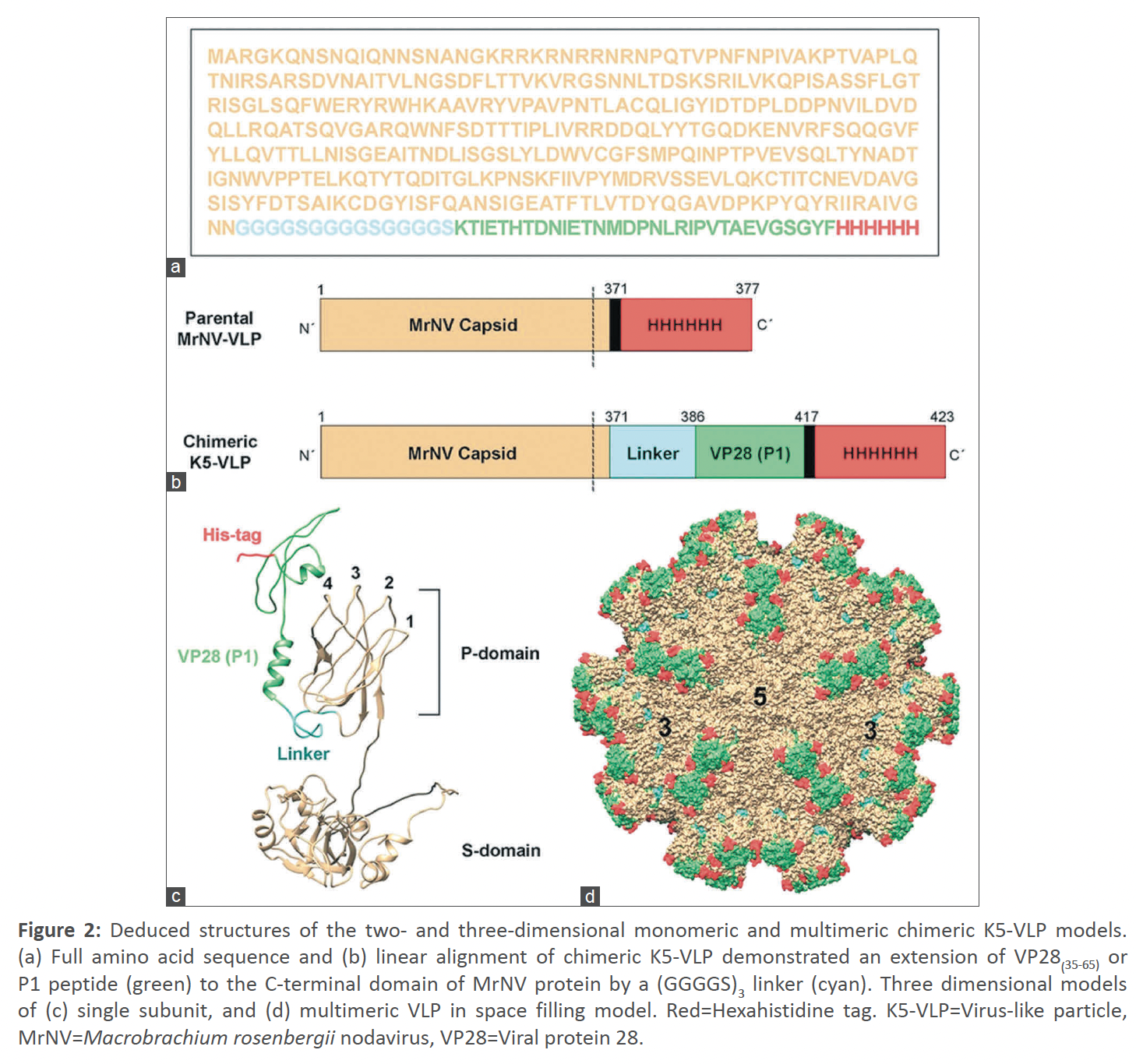
Results: Full-length VP28 exhibited strong binding to gill, hemocyte, and muscle tissues. The P1 and P2 peptides showed moderate binding compared to rVP28. Notably, K5-VLP demonstrated a 1.7-fold higher binding affinity than rVP28 in gill tissues and significantly outperformed P1 and P2 peptides. Inhibition assays confirmed that K5-VLP more effectively interfered with VP28 binding than peptides. Structural analysis and transmission electron microscopy confirmed correct assembly and surface presentation of VP28 on the VLPs.
Conclusion: Multimeric display of VP28 on K5-VLP enhances its binding affinity to shrimp tissues compared to monomeric or peptide forms. This suggests a promising platform for antiviral strategies, including competitive inhibition of WSSV entry and targeted therapeutic delivery in shrimp aquaculture.
KEYWORDS: aquaculture vaccines, Macrobrachium rosenbergii nodavirus, shrimp immunity, tissue binding, virus-like particles, viral protein 28, white spot syndrome virus
Citation: Jaranathummakul S, Jariyapong P, Thongsum O, Boonkua S, Chotwiwatthanakun C, Somrit M, Asuvapongpatana S, Wathammawut A, Weerachatyanukul W. Multivalent display of VP28 on chimeric virus-like particles enhances binding to shrimp target tissues: A novel antiviral strategy against white spot syndrome virus. Veterinary World, 2025, 18(8), 2194–2205. https://doi.org/10.14202/vetworld.2025.2194-2205.
RELATED SDGs:
14. LIFE BELOW WATER
ผู้ให้ข้อมูล: รองศาสตราจารย์ ดร.วัฒนา วีรชาติยานุกูล
ชื่ออาจารย์ที่ทำวิจัย: รองศาสตราจารย์ ดร.วัฒนา วีรชาติยานุกูล รองศาสตราจารย์ ดร.สมลักษณ์ อสุวพงษ์พัฒนา ผู้ช่วยศาสตราจารย์ ดร.มนสิชา สมฤทธิ์
แหล่งทุนวิจัย: Development and Promotion of Science and Technology Talents Project (DPST), Thailand,
Credit ภาพถ่าย: รองศาสตราจารย์ ดร.วัฒนา วีรชาติยานุกูล รองศาสตราจารย์ ดร.สมลักษณ์ อสุวพงษ์พัฒนา ผู้ช่วยศาสตราจารย์ ดร.มนสิชา สมฤทธิ์
ชื่อนักศึกษาที่ทำวิจัย: Somkid Jaranathummakul, Orawan Thongsum, Supawich Boonkua
Webmaster: ว่าที่ ร.อ. นเรศ จันทรังสิกุล
Tags: aquaculture vaccines, Macrobrachium rosenbergii nodavirus, shrimp immunity, tissue binding, virus-like particles, viral protein 28, white spot syndrome virus