
การดึงคอเลสเตอรอลออกจากเยื่อหุ้มอสุจิโดยอาศัยโปรตีน Niemann–Pick ชนิด C2 กระตุ้นการปรับเปลี่ยนอสุจิที่คล้ายกระบวนการ capacitation ระหว่างการเคลื่อนผ่านทางเดินสืบพันธุ์ของปูทะเล (Portunus pelagicus)
Highlight
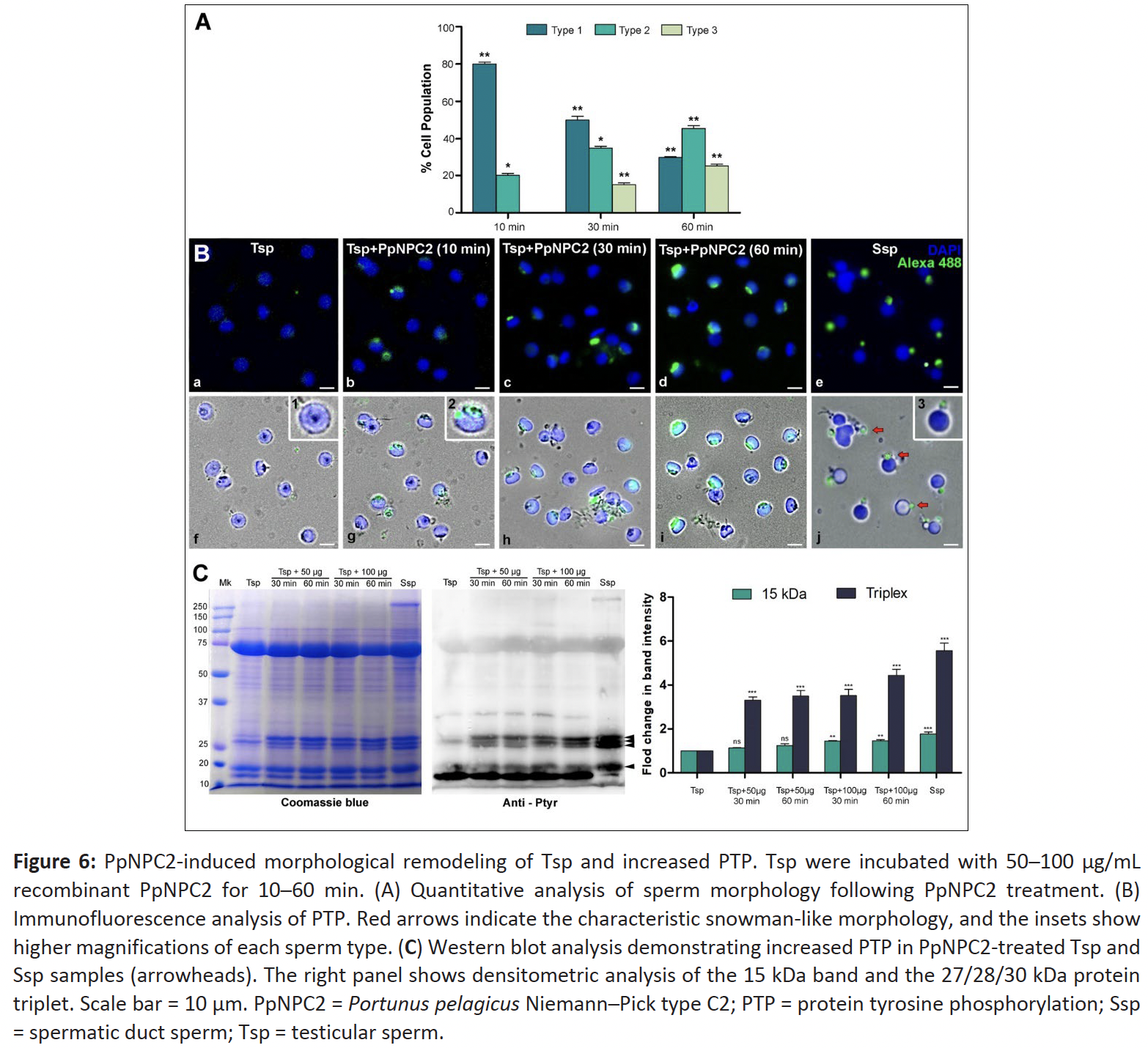
ในสัตว์เลี้ยงลูกด้วยนม การลดคอเลสเตอรอลออกจากเยื่อหุ้มอสุจิเป็นขั้นตอนหนึ่งที่ช่วยให้อสุจิพร้อมทำงาน แต่ในปูยังไม่ทราบชัดว่ามีกลไกคล้ายกันหรือไม่ งานวิจัยนี้ศึกษายีน PpNPC2 และโปรตีน NPC2 ในปูทะเล (Portunus pelagicus) ซึ่งสามารถจับคอเลสเตอรอลได้ โดยตรวจดูตำแหน่งที่พบในระบบสืบพันธุ์เพศผู้ และทดสอบโปรตีนที่ผลิตขึ้นในห้องปฏิบัติการกับอสุจิจากอัณฑะ ผลพบว่า NPC2 ปรากฏในเนื้อเยื่อของอัณฑะและท่อนำอสุจิ ระหว่างที่อสุจิเคลื่อนผ่านระบบสืบพันธุ์ ปริมาณคอเลสเตอรอลในเยื่อหุ้มลดลงประมาณ 32% และรูปร่างของอสุจิค่อย ๆ เปลี่ยนจากทรงกลมเป็นลักษณะคล้ายตุ๊กตาหิมะ เมื่อเติมโปรตีน NPC2 สังเคราะห์ ก็พบการลดคอเลสเตอรอลและการเปลี่ยนแปลงรูปร่างที่คล้ายกัน อีกทั้งพบการเพิ่มขึ้นของการเปลี่ยนแปลงโปรตีนภายในอสุจิ ซึ่งอาจเกี่ยวข้องกับการกระตุ้นการทำงานของอสุจิ ผลการศึกษาชี้ว่า NPC2 อาจช่วยปรับเปลี่ยนอสุจิให้พร้อมทำงานระหว่างการเจริญเต็มที่ในปู และเป็นข้อมูลพื้นฐานสำหรับการศึกษาเพิ่มเติมด้านการสืบพันธุ์ การเก็บรักษาอสุจิ และการเพาะเลี้ยงสัตว์น้ำ
ที่มาและความสำคัญ
งานวิจัยนี้ศึกษาการเปลี่ยนแปลงของอสุจิปูทะเล (Portunus pelagicus) ระหว่างการเดินทางผ่านระบบสืบพันธุ์เพศผู้ โดยเน้นบทบาทของโปรตีน PpNPC2 ซึ่งจับกับคอเลสเตอรอลได้ดี ในสัตว์เลี้ยงลูกด้วยนม การลดคอเลสเตอรอลจากเยื่อหุ้มอสุจิเป็นขั้นตอนสำคัญที่ช่วยให้อสุจิพร้อมทำงาน แต่กลไกที่คล้ายกันในปูยังไม่ชัดเจน งานวิจัยนี้จึงมุ่งศึกษายีน PpNPC2 ตำแหน่งที่พบในระบบสืบพันธุ์เพศผู้ และความเกี่ยวข้องกับการปรับเปลี่ยนเยื่อหุ้มอสุจิที่อาจอาศัยคอเลสเตอรอล
Abstract
Background and Aim: Cholesterol (CHO) sequestration from the sperm plasma membrane is a fundamental event during mammalian sperm capacitation, but the molecular mechanisms underlying capacitation-like sperm activation in brachyuran crabs remain unknown. Although Niemann–Pick type C2 (NPC2), a high-affinity CHO-binding protein, has been implicated in sperm maturation in penaeid shrimp, its occurrence and physiological role in brachyuran species have not been investigated. This study characterized the Portunus pelagicus NPC2 (PpNPC2) gene, determined its localization in the male reproductive tract, and evaluated its role in capacitation-like sperm remodeling during reproductive tract transit in CHO-dependent capacitation.
Materials and Methods: The PpNPC2 sequence was identified and analyzed using comparative molecular and phylogenetic approaches. Localization of PpNPC2 in the testis and spermatic duct was examined by immunohistochemistry. Recombinant PpNPC2 protein was produced in Escherichia coli and functionally evaluated using isolated testicular sperm. Membrane CHO content was quantified by high-performance thin-layer chromatography and Filipin III fluorescence staining, whereas sperm morphology and protein tyrosine phosphorylation were assessed using light microscopy, immunofluorescence, and Western blotting.
Results: PpNPC2 encoded a conserved NPC2 protein that clustered phylogenetically with crustacean NPC2 homologs and was predominantly localized in epithelial cells of the testis and spermatic duct. During sperm transit, membrane CHO decreased by approximately 32%, accompanied by progressive transformation of round testicular sperm into characteristic snowman-like spermatic duct sperm. Recombinant PpNPC2 reproduced these physiological changes by promoting CHO sequestration, inducing time- and concentration-dependent morphological remodeling, and significantly increasing protein tyrosine phosphorylation by up to 2.33-fold (p < 0.01). These findings indicate that PpNPC2 functions as a CHO-sequestering protein that initiates capacitation-like biochemical and structural remodeling during sperm maturation.
Conclusion: This study provides the first molecular and functional characterization of NPC2 in a brachyuran crab and demonstrates that NPC2-mediated CHO sequestration is a conserved mechanism driving capacitation-like sperm activation during reproductive tract transit. These findings expand current understanding of reproductive biology in marine crustaceans and provide a molecular foundation for future studies on sperm preservation, assisted reproduction, and crustacean aquaculture.
KEYWORDS: Brachyuran crab, cholesterol sequestration, external fertilization, Niemann–Pick type C2, Portunus pelagicus, protein tyrosine phosphorylation, sperm capacitation-like process, sperm remodeling.
Citation: Wattana Weerachatyanukul, Thanyaporn Senarai, Thitiporn Khongkha, Orawan Thongsum, Supawich Boonkua, Jirawat Saetan, Piyaporn Surinlert, Somluk Asuvapongpatana. Niemann–Pick type C2-mediated cholesterol sequestration induces capacitation-like sperm remodeling during reproductive tract transit in the blue swimming crab (Portunus pelagicus). Vet World. 2026;19(8):3651–3667. https://doi.org/10.14202/vetworld.2026.3651-3667
RELATED SDGs:
14. LIFE BELOW WATER
ผู้ให้ข้อมูล: รองศาสตราจารย์ ดร.สมลักษณ์ อสุวพงษ์พัฒนา
ชื่ออาจารย์ที่ทำวิจัย: รองศาสตราจารย์ ดร.สมลักษณ์ อสุวพงษ์พัฒนา รองศาสตราจารย์ ดร.วัฒนา วีรชาติยานุกูล
แหล่งทุนวิจัย: Mahidol University (Fundamental Fund: fiscal Year 2024 by the National Science Research and Innovation Fund (NSRF))
Credit ภาพถ่าย: รองศาสตราจารย์ ดร.สมลักษณ์ อสุวพงษ์พัฒนา รองศาสตราจารย์ ดร.วัฒนา วีรชาติยานุกูล
ชื่อนักศึกษาที่ทำวิจัย: ฐิติพร คงคา อรวรรณ ทองสุม ศุภวิชญ์ บุญเกื้อ
Webmaster: ว่าที่ ร.อ. นเรศ จันทรังสิกุล
Tags: Brachyuran crab, cholesterol sequestration, external fertilization, Niemann–Pick type C2, Portunus pelagicus, protein tyrosine phosphorylation, sperm capacitation-like process, sperm remodeling