
การใช้อนุภาคคล้ายไวรัสเป็นกลยุทธ์ต้านโรคไวรัสในกุ้ง
Highlight
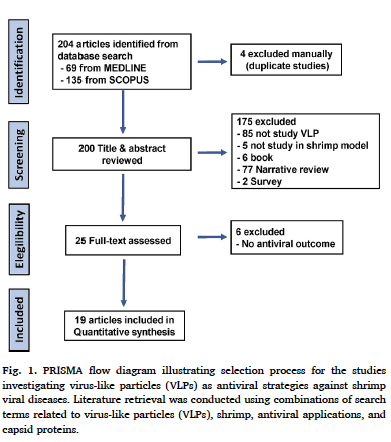
อนุภาคคล้ายไวรัส (VLPs) อาจช่วยนำสารต้านไวรัสเข้าสู่กุ้งโดยไม่ก่อการติดเชื้อ จากงานวิจัย 19 เรื่อง ประมาณ 63% พบว่ากุ้งรอดมากขึ้นหรือตายน้อยลง และ 47% พบปริมาณไวรัสลดลง อย่างไรก็ตาม ยังต้องมีการทดลองด้วยวิธีมาตรฐานและทดสอบในฟาร์มจริงเพิ่มเติม.
ที่มาและความสำคัญ
โรคไวรัสเป็นปัญหาสำคัญที่สร้างความเสียหายและคุกคามความยั่งยืนของการเพาะเลี้ยงกุ้ง
จึงจำเป็นต้องพัฒนาวิธีป้องกันและควบคุมโรคที่มีประสิทธิภาพและปลอดภัย
อนุภาคคล้ายไวรัส (VLPs) ไม่มีสารพันธุกรรมที่ก่อการติดเชื้อได้ และอาจใช้เป็นพาหะนำสารต้านไวรัสเข้าสู่กุ้ง
การทบทวนงานวิจัยที่ผ่านมาแสดงแนวโน้มว่า VLPs ช่วยเพิ่มการรอดชีวิตและลดปริมาณไวรัสในกุ้งได้
Abstract
Viral diseases continue to threaten the sustainability of shrimp aquaculture, prompting the urgent development of innovative antiviral strategies. Virus-like particles (VLPs), self-assembled viral capsid structures lacking infectious genomes, have emerged as well-established nanoplatforms with potential applications in molecular delivery and antiviral intervention in aquatic species. This systematic review synthesizes current evidence on the design and biophysical properties of VLP-based platforms in shrimp. Literature searches were conducted in PubMed and Scopus between December 2025 and February 2026, and studies investigating VLP- or capsid-based applications in shrimp models with antiviral-related outcomes were included. Nineteen studies met the inclusion criteria. Most studies focused on penaeid shrimp, particularly Penaeus vannamei, and primarily targeted white spot syndrome virus (WSSV). The majority of VLP constructs were derived from shrimp viral capsid proteins and produced in Escherichia coli, and were subsequently used to encapsulate dsRNA targeting viral structural genes. Across in vivo challenge models, 63.16% of studies reported improved survival or reduced mortality compared with controls, while 47.37% demonstrated reduced viral load following VLP-based treatment. Although heterogeneity in construct design and experimental conditions limits direct comparison, current evidence supports the potential of VLP platforms as multifunctional antiviral systems in shrimp. Standardized evaluation frameworks and field-relevant validation will be essential to advance their translational application in aquaculture.
KEYWORDS: Virus-like particles, Shrimp viral diseases, Antiviral response, Crustacean immunity, Aquaculture disease control
Citation: Jariyapong, P., Pooljun, C., & Weerachatyanukul, W. (2026). Virus-like particles as antiviral strategies against shrimp viral diseases. Journal of Invertebrate Pathology, 218, 108654. https://doi.org/10.1016/j.jip.2026.108654
RELATED SDGs:
14. LIFE BELOW WATER
ผู้ให้ข้อมูล: รองศาสตราจารย์ ดร.วัฒนา วีรชาติยานุกูล
ชื่ออาจารย์ที่ทำวิจัย: รองศาสตราจารย์ ดร.วัฒนา วีรชาติยานุกูล
Credit ภาพถ่าย: รองศาสตราจารย์ ดร.วัฒนา วีรชาติยานุกูล
Webmaster: ว่าที่ ร.อ. นเรศ จันทรังสิกุล
Tags: Virus-like particles, Shrimp viral diseases, Antiviral response, Crustacean immunity, Aquaculture disease control