
กลยุทธ์การออกแบบเพื่อแสดงโมเลกุลต่างชนิดบนอนุภาคคล้ายไวรัสที่พัฒนาจากไวรัสโนดาของกุ้งก้ามกราม (Macrobrachium rosenbergii nodavirus): การทบทวนอย่างเป็นระบบ
Highlight
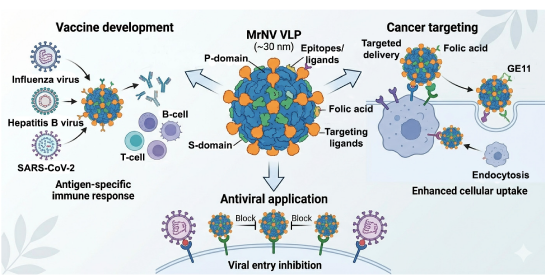
อนุภาคคล้ายไวรัส (virus-like particles; VLPs) เป็นโครงสร้างขนาดเล็กที่มีลักษณะคล้ายอนุภาคไวรัส แต่สามารถนำมาดัดแปลงให้แสดงโมเลกุลชนิดอื่นบนผิวได้ โดย VLPs ที่พัฒนาจากไวรัส Macrobrachium rosenbergii nodavirus (MrNV) เป็นหนึ่งในแพลตฟอร์มที่มีศักยภาพ งานทบทวนนี้รวบรวมและสังเคราะห์ผลการศึกษาที่เข้าเกณฑ์ 20 เรื่องตามแนวทาง PRISMA เพื่อสำรวจวิธีนำโมเลกุลอื่นมาแสดงบน MrNV VLPs และพิจารณาว่าขนาดและโครงสร้างของโมเลกุลที่ต้องการแสดงมีผลต่อการเลือกวิธีอย่างไร บริเวณที่ใช้แสดงโมเลกุลอื่นเป็นหลักคือส่วน P ซึ่งอยู่ทางปลายด้าน C ของโปรตีนเปลือกอนุภาค วิธีที่ใช้มีทั้งการเชื่อมสารพันธุกรรมให้สร้างโปรตีนร่วมกัน การแทรกเปปไทด์ และการแทนที่บางส่วนของโดเมน วิธีเลือกใช้ขึ้นอยู่กับลักษณะของโมเลกุลที่ต้องการแสดง การศึกษาที่รายงานการสร้างอนุภาคโดยตรงพบว่าสามารถแสดงได้ทั้งเปปไทด์ขนาดเล็กและโดเมนโปรตีนขนาดใหญ่ โดยยังคงโครงสร้างของอนุภาคไว้ได้ อย่างไรก็ตาม งานวิจัยบางส่วนไม่ได้รายงานการประกอบตัวของอนุภาค และหลักฐานโดยรวมยังมีความหลากหลายและส่วนใหญ่อยู่ในระยะก่อนการทดลองทางคลินิก ผลการทบทวนนี้จึงช่วยให้เห็นแนวทางเลือกวิธีออกแบบ MrNV VLPs ตามลักษณะของโมเลกุลที่ต้องการแสดง และเป็นข้อมูลตั้งต้นสำหรับการพัฒนาแพลตฟอร์มนี้เพื่อการประยุกต์ใช้ทางชีวการแพทย์
ที่มาและความสำคัญ
VLPs เป็นโครงสร้างคล้ายไวรัสที่สามารถดัดแปลงให้แสดงโมเลกุลอื่นบนผิว และมีศักยภาพสำหรับการประยุกต์ใช้ทางชีวการแพทย์ การเลือกใช้ MrNV VLPs เป็นแพลตฟอร์มหนึ่งที่ใช้ดัดแปลงโมเลกุลโดยเฉพาะโดเมน P วิธีออกแบบมีหลายแบบ และการเลือกใช้ขึ้นกับขนาดและโครงสร้างของโมเลกุลเป้าหมาย การทบทวนงานวิจัย 20 เรื่องนี้ช่วยสรุปแนวทางออกแบบและความสัมพันธ์ระหว่างลักษณะของโมเลกุลกับวิธีที่เลือกใช้
Abstract
Virus-like particles (VLPs) are nanoscale platforms that can be engineered for heterologous molecule display. Among the available VLP platforms, Macrobrachium rosenbergii nodavirus-derived VLPs (MrNV VLPs) have emerged as a promising system for this purpose. Following the Preferred Reporting Items for Systematic Reviews and Meta-Analyses (PRISMA) guidelines, 20 eligible studies were identified and qualitatively synthesized to summarize the current design strategies used for heterologous molecule display on MrNV VLPs, with a particular focus on how insert characteristics influence the selection of design strategies. The protruding (P) domain, located at the C-terminal region, serves as the main site for heterologous display. Different strategies, including genetic fusion, peptide insertion, and domain replacement, are applied depending on the size and structural complexity of the insert. Across the available studies, these approaches enabled the display of both small peptides and larger protein domains, with particle architecture maintained in studies that directly evaluated and reported VLP formation. In addition to design strategies, physicochemical properties, including structural stability, are important considerations that may influence platform performance. However, several studies did not directly report VLP assembly, and the available evidence remains heterogeneous and predominantly preclinical. Together, this review highlights the relationship between insert characteristics and design strategies in MrNV VLPs and provides insights for the rational design of VLP-based heterologous molecule display platforms for biomedical applications.
KEYWORDS: virus-like particles; heterologous molecule display; Macrobrachium rosenbergii nodavirus; design strategies; biomedical applications
Citation: Weerachatyanukul W, Thongsum O, Jariyapong P (2026). Design strategies for heterologous molecule display using Macrobrachium rosenbergii Nodavirus-like particles: A systematic review. Applied Biosciences, 5(3), 77. https://doi.org/10.3390/applbiosci5030077
RELATED SDGs:
14. LIFE BELOW WATER
ผู้ให้ข้อมูล: รองศาสตราจารย์ ดร.วัฒนา วีรชาติยานุกูล
ชื่ออาจารย์ที่ทำวิจัย: รองศาสตราจารย์ ดร.วัฒนา วีรชาติยานุกูล
แหล่งทุนวิจัย: MU-NSTDA Joint Funding
Credit ภาพถ่าย: รองศาสตราจารย์ ดร.วัฒนา วีรชาติยานุกูล
ชื่อนักศึกษาที่ทำวิจัย: นางสาวอรวรรณ ทองสุม
Webmaster: ว่าที่ ร.อ. นเรศ จันทรังสิกุล
Tags: virus-like particles, heterologous molecule display, Macrobrachium rosenbergii nodavirus, design strategies, biomedical applications