
Highlight
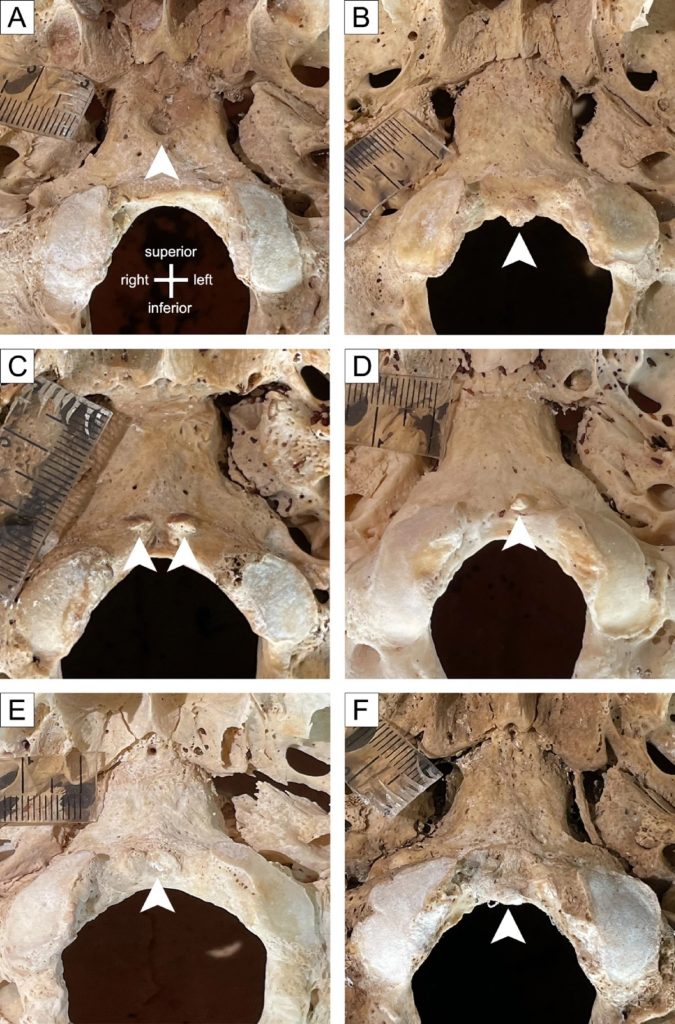
การศึกษาพบความแปรผันทางกายวิภาคของ clivus ในร้อยละ 12.5 ของกะโหลกศีรษะแห้งจากประชากรภาคตะวันออกเฉียงเหนือของไทย โดยร่อง fossa navicularis magna และตุ่มที่ขอบด้านหน้าของ foramen magnum เป็นความแปรผันที่พบได้บ่อยที่สุด ข้อมูลนี้มีประโยชน์ต่อการตีความภาพและการวางแผนทางศัลยกรรมฐานกะโหลกศีรษะ
ที่มาและความสำคัญ
การแปรผันทางกายวิภาคของกระดูก clivus ซึ่งเป็นส่วนฐานของกะโหลกศีรษะที่อยู่ใกล้โครงสร้างทางประสาทและหลอดเลือดสำคัญ มีความเกี่ยวข้องทั้งในด้านคลินิกและพัฒนาการ แต่มีข้อมูลจำกัดในประชากรเอเชียตะวันออกเฉียงใต้ การศึกษานี้จึงตรวจสอบความชุกและลักษณะมอร์โฟเมตริกของความแปรผันต่าง ๆ ของกระดูก clivus ในกะโหลกศีรษะแห้งจากประชากรภาคตะวันออกเฉียงเหนือของไทยจำนวน 304 ซาก โดยประเมินรูปร่าง ขนาด ความสูง และความกว้างของความแปรผันที่พบมากที่สุด เช่น ร่อง fossa navicularis magna และตุ่มที่ขอบด้านหน้าของ foramen magnum โดยพบความแปรผันเหล่านี้ในร้อยละ 12.5 ของตัวอย่าง ซึ่งเป็นข้อมูลพื้นฐานที่สำคัญสำหรับการตีความภาพถ่ายทางรังสีและการผ่าตัดฐานกะโหลกศีรษะในบริบททางคลินิกและกายวิภาคศาสตร์
Abstract
Purpose
Anatomical variations of the clivus may have clinical and embryological relevance but remain underexplored in specific populations. This study investigated the prevalence and morphometric characteristics of clival anatomical variants in dried human skulls from the Northeastern Thai population.
Methods
Three hundred four dried human skulls (282 males, 22 females) were examined macroscopically. Variations of the clivus were identified and recorded by two independent observers, with discrepancies resolved by consensus. Descriptive statistics were used to report prevalence. Morphometric measurements (height and breadth) were taken for applicable variants using a digital caliper. Chi-square tests assessed sex differences.
Results
Fossa navicularis magna and tubercle at the anterior margin of the foramen magnum were the most prevalent variants, each observed in 38 skulls (12.5%). The basilar processes were found in 12 skulls (3.9%), condylus tertius in 5 skulls (1.6%), and prebasioccipital arch in 1 skull (0.3%). These variations showed variable morphometry. Fossa navicularis magna averaged 5.1 mm in height and 4.1 mm in breadth; tubercle at the anterior margin of the foramen magnum, 2.7 mm in breadth; basilar processes, 3.9 mm in height; condylus tertius, 6.3 mm in height and 6.9 mm in breadth; and prebasioccipital arch, 10.5 mm in height and 15.5 mm in breadth. No significant sex differences were found for fossa navicularis magna (p = 0.40), tubercle at the anterior margin of foramen magnum (p = 0.61) or basilar process (p = 0.67).
Conclusion
Clival variants, especially fossa navicularis magna and anterior tubercles, were found in 12.5% of skulls in this first study on Northeastern Thais. These may impact imaging interpretation and skull base surgery, reiterating the need for anatomical awareness in clinical contexts.
KEYWORDS: Clivus, Anatomical variation, Morphometry, Skull base, Northeastern Thai population
Citation: Yurasakpong, L., Suwannakhan, A., Asuvapongpatana, S. et al. Anatomical and morphometric study of variations of the clivus in dried human skulls from the northeastern Thai population. Surg Radiol Anat47, 214 (2025). https://doi.org/10.1007/s00276-025-03732-7
RELATED SDGs:
3. GOOD HEALTH AND WELL-BEING

ผู้ให้ข้อมูล: ผู้ช่วยศาสตราจารย์ ดร.อธิคุณ สุวรรณขันธ์
ชื่ออาจารย์ที่ทำวิจัย: ผู้ช่วยศาสตราจารย์ ดร.ลภัสรดา ยุรศักดิ์พงศ์
ผู้ช่วยศาสตราจารย์ ดร.อธิคุณ สุวรรณขันธ์ รองศาสตราจารย์ ดร.สมลักษณ์ อสุวพงษ์พัฒนา
Credit ภาพ: ผู้ช่วยศาสตราจารย์ ดร.ลภัสรดา ยุรศักดิ์พงศ์
Webmaster: ว่าที่ ร.อ. นเรศ จันทรังสิกุล
Tags: anatomical variation, Clivus, Morphometry, Northeastern Thai population, Skull base