
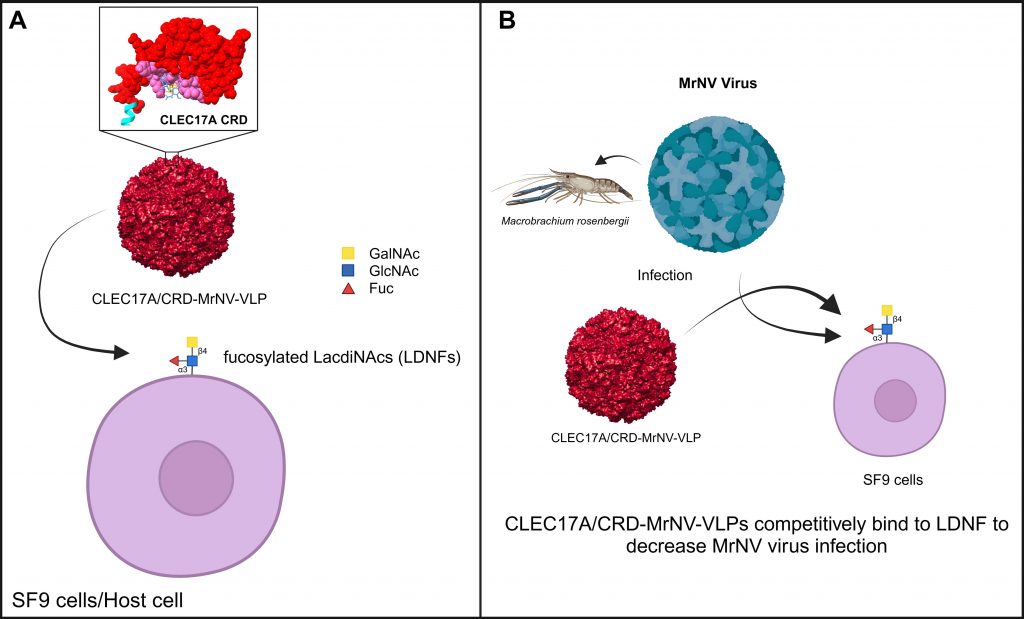
อนุภาคคล้ายไวรัสที่ดัดแปลงให้มี CLEC17A สามารถลดการติดเชื้อของ Macrobrachium rosenbergii nodavirus ในเซลล์ Sf9 ได้อย่างมีนัยสำคัญ
Highlight
งานวิจัยนี้แสดงให้เห็นว่าอนุภาคโนด้าไวรัสที่ดัดแปลงส่วนยื่นให้มีความจำเพาะกับ CLEC17A ( CLEC17A/CRD-MrNV-VLPs ) มีความสามารถในการจับกับกลุ่มของน้ำตาลฟูโคสได้อย่างมีประสิทธิภาพ และมีศักยภาพสูงในการพัฒนาเป็นอนุภาคโนนาที่ช่วยลดการติดเชื้อของ MrNV ในเซลล์ที่ไวต่อการติดเชื้อได้อย่างมีนัยสำคัญ
ที่มาและความสำคัญ
การสร้างและดัดแปลงอนุภาคโนด้าไวรัส MrNV-VLPs ให้มีความจำเพาะต่อกลุ่มน้ำตาลฟูโคสบนเปลือกหุ้ม คาดว่าจะสามารถยับยั้งการติดเชื้อไวรัสได้อย่างมีประสิทธิภาพ เนื่องโนด้าไวรัส ใช้กลุ่มน้ำตาลฟูโคสในการจับและเข้าสู่เซลล์ นอกจากนี้อนุภาคโนด้าไวรัสยังมีคุณสมบัติเด่นด้านความเสถียร และความแรงของการจับ (avidity) ที่สูง นอกจากนี้ยังสามารถนำมาใช้ประโยชน์ได้ง่าย เนื่องจากสามารถผลิต ปริมาณมาก เก็บรักษา และใช้งานได้ง่ายกว่าเลคทินหรือไกลแคนแบบดั้งเดิม
Abstract
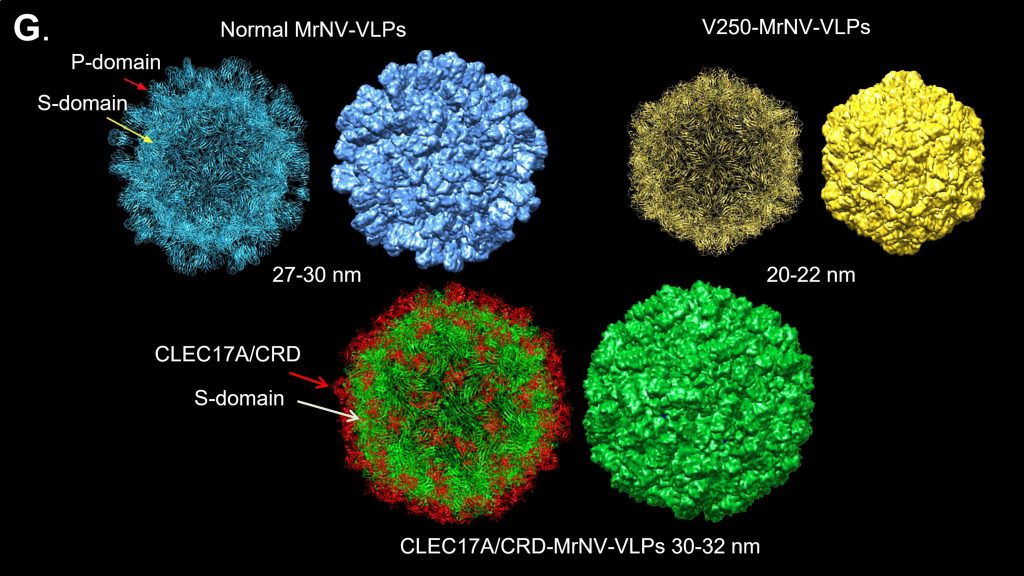
Our previous studies demonstrated that Macrobrachium rosenbergii nodavirus (MrNV) infects and replicates in Sf9 insect cells, where fucosylated N- and O-glycans (HexNAc (Fuc)HexNAc-R or Fuc-LacdiNAc) serve as essential binding molecules for viral attachment. Additionally, we showed that the virus-like particles of the virus itself (MrNV-VLPs) were able to bind to the white-tail disease (WTD)-associated tissues and infect Sf9 cells; and these processes were significantly reduced by removing 27 amino acids from the C-terminus of the protruding (P) domain. In this study, we demonstrated that icosahedral particles could still form following the truncation of the P-domain at sites adjacent to known calcium-binding domains (CBDs) present in the S-shell domain in the MrNV capsid protein. We further showed that icosahedral particles could still form after truncation of the P-domain near calcium-binding sites in the S-domain. This generated smaller but intact particles lacking protrusions, designated V250-MrNV-VLPs. The particles with their intact S-shells enabled our complete replacement of the original MrNV capsid protein P-domains with the fucose-binding carbohydrate-recognition domain (CRD) of CLEC17A lectin (Prolectin), successfully creating CLEC17A/CRD-MrNV-VLPs. The chimeric CLEC17A/CRD-MrNV-VLPs were stable icosahedral particles with P-domains structurally distinct from both the smooth V250-MrNV-VLPs and the blade-like domains of wild-type MrNV-VLPs. Furthermore, the chimeric VLPs presented specific binding activities towards immobilized fucosylated glycoconjugates and Sf9 cell protein lysates. Notably, CLEC17A/CRD-MrNV-VLPs were able to reduce MrNV binding and infection in Sf9 cells. Therefore, this study demonstrated the potential for CLEC17A/CRD-MrNV-VLPs as particles that can effectively bind to fucosylated glycans, and their potential development as nanoparticles that can significantly reduce the level of infection by MrNV in susceptible cells.
KEYWORDS: Nodavirus, Virus-like particles, Glycans, Fucosylated lacdinacs, Carbohydrate-recognition domains, Prolectin
Citation: Chantunmapitak, R., Boonkua, S., Thongsum, O. et al. Chimeric virus-like particles carrying the CLEC17A carbohydrate-recognition domain significantly reduce Macrobrachium rosenbergii nodavirus infection in Sf9 cells. Sci Rep 15, 43311 (2025). https://doi.org/10.1038/s41598-025-27357-3
RELATED SDGs:
SDG Goal หลัก ที่เกี่ยวข้อง
2. ZERO HUNGER

SDG Goal ที่เกี่ยวข้องอื่น ๆ
17. Partnerships for the goals

ผู้ให้ข้อมูล: ผู้ช่วยศาสตราจารย์ ดร.มนสิชา สมฤทธิ์
ชื่ออาจารย์ที่ทำวิจัย: รองศาสตราจารย์ ดร.วัฒนา วีรชาติยานุกูล รองศาสตราจารย์ ดร.สมลักษณ์ อสุวพงษ์พัฒนา ผู้ช่วยศาสตราจารย์ ดร.มนสิชา สมฤทธิ์
ชื่อนักศึกษาที่ทำวิจัย: น.ส.เรืองทิพย์ จันธรรมาพิทักษ์ น.ส.อรวรรณ ทองสุม นายศุภวิชญ์ บุญเกื้อ
ภาพถ่าย: ผู้ช่วยศาสตราจารย์ ดร.มนสิชา สมฤทธิ์
แหล่งทุนวิจัย: ทุนอุดหนุนการวิจัยจากสำนักงานปลัดกระทรวงการอุดมศึกษา วิทยาศาสตร์ วิจัยและนวัตกรรม ภายใต้โปรแกรม 1 สร้างระบบผลิตและพัฒนากำลังคนให้มีคุณภาพ แผนงาน ทุนพัฒนาศักยภาพในการทำงานวิจัยของอาจารย์รุ่นใหม่
Tags: Carbohydrate-recognition domains, Fucosylated lacdinacs, glycans, nodavirus, Prolectin, virus-like particles