
Highlight
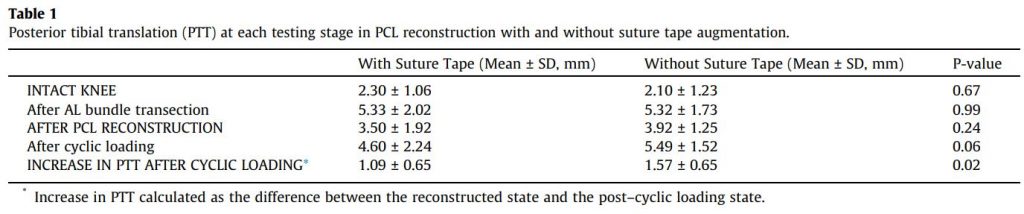
การเสริมด้วย suture tape สามารถลดการเพิ่มขึ้นของ posterior tibial translation ภายใต้ภาวะ cyclic loading ได้อย่างมีประสิทธิภาพ สะท้อนถึงความมั่นคงเชิงพลวัตของข้อเข่าที่ดีขึ้น และศักยภาพในการปกป้องเส้นเอ็นปลูกถ่ายในระยะแรกหลังการผ่าตัดสร้าง PCL แบบ single-bundle reconstruction
ที่มาและความสำคัญ
ความหลวมคงเหลือ (residual laxity) หลังการผ่าตัดสร้างเอ็นไขว้หลังข้อเข่า (posterior cruciate ligament; PCL) แบบเส้นเอ็นเดี่ยว (single-bundle reconstruction) ยังคงเป็นปัญหาทางคลินิกที่อาจส่งผลกระทบต่อผลลัพธ์ด้านการใช้งานของข้อเข่าหลังผ่าตัดได้ การเสริมด้วยแถบเทปเย็บ (suture tape augmentation) ได้ถูกนำมาใช้เป็นเทคนิค internal brace เพื่อช่วยปกป้องเส้นเอ็นปลูกถ่าย (graft) และลดความหลวมของข้อเข่าในระยะแรกหลังการผ่าตัด
การศึกษานี้มีวัตถุประสงค์เพื่อประเมินว่าประสิทธิภาพการเสริมด้วย suture tape สามารถลดการเคลื่อนตัวไปด้านหลังของกระดูกหน้าแข้ง (posterior tibial translation; PTT) และการยืดตัวของเส้นเอ็นปลูกถ่าย (graft elongation) ภายใต้สภาวะการรับแรงซ้ำ ๆ (cyclic loading) ในการผ่าตัดสร้างเอ็นไขว้หลังข้อเข่าแบบเส้นเอ็นเดี่ยวได้

Abstract
Background
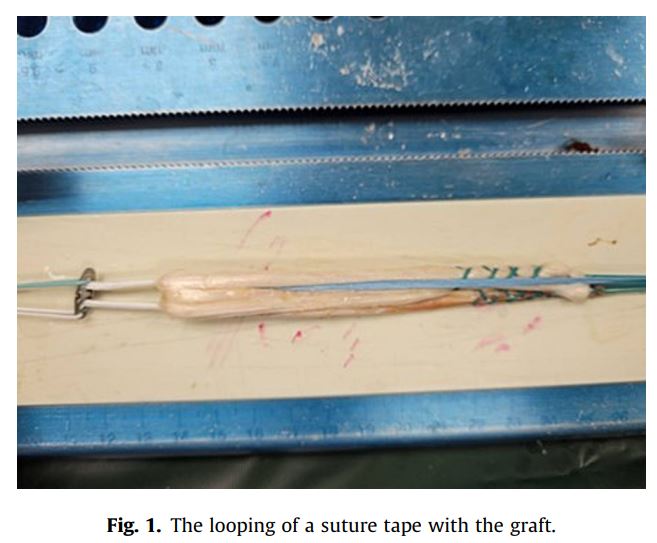
Residual laxity after single-bundle posterior cruciate ligament (PCL) reconstruction remains a clinical concern that may compromise functional outcomes. Suture tape augmentation has been introduced as an internal bracing technique to enhance graft protection and reduce early postoperative laxity. This study aimed to determine whether suture tape augmentation reduces posterior tibial translation (PTT) and graft elongation under cyclic loading in single-bundle PCL reconstruction.
Methods
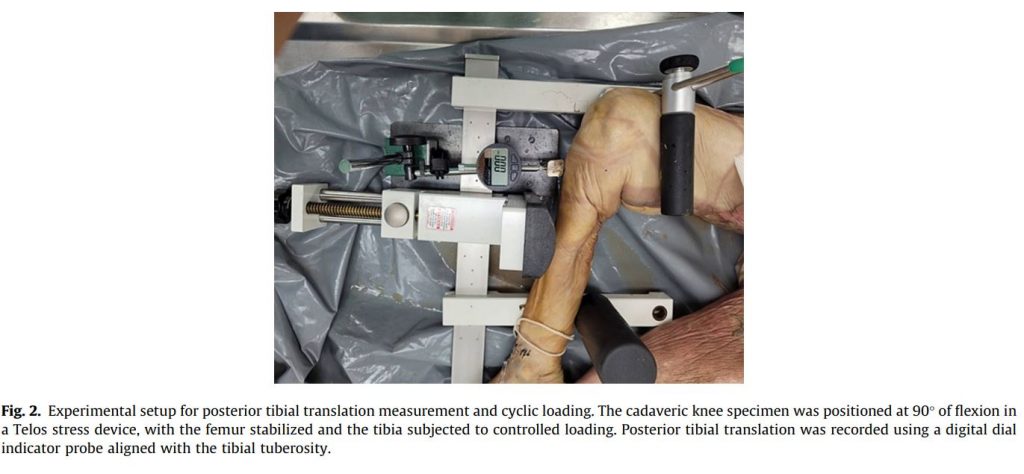
Eight fresh-frozen human cadavers (16 knees) underwent bilateral single-bundle PCL reconstruction. One knee in each pair received suture tape augmentation, while the contralateral knee served as control. Posterior tibial translation was measured at 90° of flexion under four conditions: intact, after partial PCL transection, after reconstruction, and after 1000 loading cycles at 1 Hz. Graft elongation, diameter, and tibial tunnel size were recorded. Paired t-tests compared groups.
Results
No significant differences in PTT were found between groups in the intact, cut, or reconstructed states. After cyclic loading, the suture tape group showed lower PTT than controls (4.60 ± 2.24 mm vs 5.49 ± 1.52 mm, p = 0.06). The increase in PTT from reconstruction to post-cyclic loading was smaller with suture tape (1.09 ± 0.65 mm vs 1.57 ± 0.65 mm, p < 0.05). Graft elongation was similar, while graft diameter and tibial tunnel size were slightly larger with suture tape (p < 0.05).
Conclusion
Suture tape augmentation limited the increase in posterior tibial translation under cyclic loading, indicating improved dynamic stability and potential graft protection in single-bundle PCL reconstruction.
Keywords: Posterior cruciate ligament reconstruction, Sutures, Biomechanical phenomena, Arthroscopy, Cadaver
Citation: Saengpetch N, Poorapeeravong A, Suriyonplengsaeng C, Aroonjarattham P, Somtua C, Kongmalai P. Biomechanical stability of single-bundle PCL reconstruction with and without suture tape augmentation: a cadaveric study. Knee. 2026 Jun 4;62:104517. doi: 10.1016/j.knee.2026.104517. Epub ahead of print. PMID: 42241893.
RELATED SDGs:
3. GOOD HEALTH AND WELL-BEING

ผู้ให้ข้อมูล: ผู้ช่วยศาสตราจารย์ นพ.ชินวุฒิ สุริยนเปล่งแสง
ชื่ออาจารย์ที่ทำวิจัย: ผู้ช่วยศาสตราจารย์ นพ.ชินวุฒิ สุริยนเปล่งแสง
แหล่งทุนวิจัย: This research did not receive any specific grant from funding agencies in the public, commercial, or not-for-profit sectors
เครดิตภาพ: ผู้ช่วยศาสตราจารย์ นพ.ชินวุฒิ สุริยนเปล่งแสง
Tags: Arthroscopy, Biomechanical phenomena, Cadaver, Posterior cruciate ligament reconstruction, Sutures