
ชื่องานวิจัยภาษาไทย
สารสกัดจากปลิงทะเลดำ (Holothuria leucospilota) ที่มี triterpenoid saponin สามารถลดความเป็นพิษของ amyloid-β ในหนอนดัดแปลงพันธุกรรม C. elegans ผ่านการกระตุ้นกลไกการกำจัดโปรตีนและการต้านความเครียดของเซลล์
Highlight
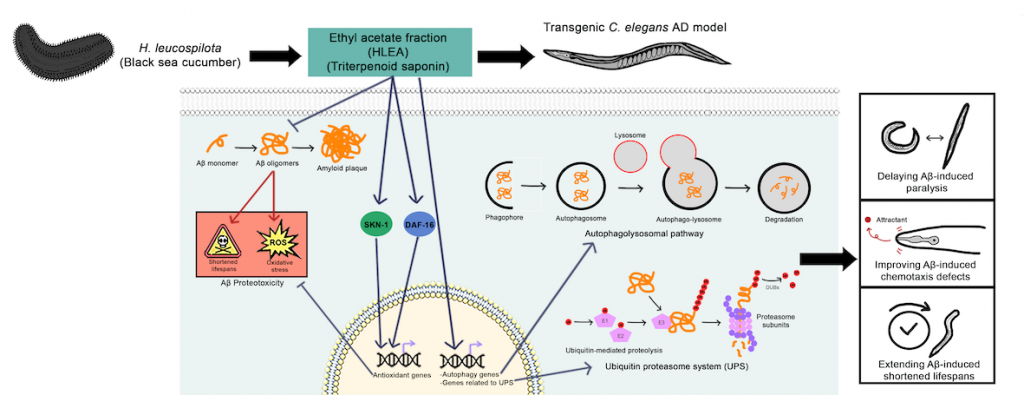
สารสกัดจากปลิงทะเลดำ (Holothuria leucospilota) ที่มี triterpenoid saponin เป็นองค์ประกอบ สามารถลดความเป็นพิษของโปรตีนอะไมลอยด์เบต้า (Aβ) ในหนอนดัดแปลงพันธุกรรม Caenorhabditis elegans ได้อย่างมีนัยสำคัญ โดยสามารถชะลอการเกิดอัมพาต ลดการสะสมของ Aβ ลดความเครียดออกซิเดชัน และกระตุ้นระบบกำจัดโปรตีนรวมถึงกลไกต้านความเครียดระดับเซลล์
ที่มาและความสำคัญ
โรคอัลไซเมอร์เป็นโรคความเสื่อมระบบประสาทลำดับต้นๆ ซึ่งปัจจุบันยังไม่มียารักษาที่มีประสิทธิภาพ ปลิงทะเลดำถูกนำมาใช้เป็นอาหารและสารบำรุงสุขภาพในประเทศแถบเอเชียอย่างยาวนาน การศึกษาวิจัยนี้จึงศึกษาการออกฤทธิ์ของสารสกัดจากปลิงทะเลดำในการลดความเป็นพิษจากการเกาะกลุ่มของโปรตีนอะไมลอยด์เบต้า ซึ่งเป็นพยาธิสภาพหลักของโรค เพื่อเป็นแนวทางในการป้องกันและรักษาโรคอัลไซเมอร์ต่อไป
Abstract
The black sea cucumber Holothuria leucospilota, an Asian traditional food and medicine, has been explored for health benefits, including neuroprotective effects. Although its anti-Parkinson’s effects have been demonstrated, its potential anti-Alzheimer’s effects remain unexplored. Therefore, this study aimed to investigate the effects and underlying mechanisms of H. leucospilota extracts on amyloid-β (Aβ) proteotoxicity in a Caenorhabditis elegans model of Alzheimer’s disease (AD). All fractions of H. leucospilota extracts were proven to be non-toxic to C. elegans. Among them, the ethyl acetate fraction (HLEA) at 500 μg/mL exhibited the greatest efficacy due to its ability to delay Aβ-induced paralysis in muscular Aβ-expressing C. elegans. Moreover, HLEA at 500 μg/mL rescued the chemotaxis defects in neuronal Aβ-expressing worms. The levels of Aβ oligomers and deposits declined after HLEA treatment of AD worms. Correspondingly, HLEA alleviated Aβ toxicity by lowering ROS levels and extending the lifespan of AD worms. Furthermore, differential RNA sequencing analysis revealed that the lysosome, proteasome, and antioxidant pathways were activated in HLEA-treated AD worms. RT-qPCR assays confirmed that HLEA upregulated ubiquitin-proteasome system, autophago-lysosomal, and antioxidant genes. Moreover, HLEA treatment promoted the nuclear localization of key transcription factors, SKN-1 and DAF-16, along with upregulation of their downstream antioxidant genes, indicating activation of SKN-1 and DAF-16 signaling pathways. Lastly, mass spectrometry analysis revealed that HLEA was predominantly composed of triterpenoid saponins. In summary, HLEA at 500 μg/mL diminished Aβ proteotoxicity by activating the protein clearance mechanism and SKN-1 and DAF-16 stress resistance pathways in the C. elegans AD model.
KEYWORDS: Holothuria leucospilota, Amyloid-β, Alzheimer’s disease, Caenorhabditis elegans, Ubiquitin proteasome system, Autophago-lysosomal pathway, Stress resistance pathway
Citation: Thongdechsri S, Kamonnat C, Sanguanphun T, Kraokaew P, Jattujan P, Niamnont N, Smith SJ, Cummins SF, Jongkamonwiwat N, Sobhon P, Meemon K*. Triterpenoid saponin-containing Holothuria leucospilota extract mitigates amyloid- proteotoxicity in transgenic C. elegans through activations of protein clearance and stress resistance pathways. Food Biosci. 2026;77:108427. DOI: 10.1016/j.fbio.2026.108427.
RELATED SDGs:
3. GOOD HEALTH AND WELL-BEING

ผู้ให้ข้อมูล: รองศาสตราจารย์ ดร.ไกร มีมล
ชื่ออาจารย์ที่ทำวิจัย: รองศาสตราจารย์ ดร.ไกร มีมล
ชื่อนักศึกษาที่ทำวิจัย: Salinthip Thongdechsri
แหล่งทุนวิจัย: National Research Council of Thailand
Credit ภาพ: รองศาสตราจารย์ ดร.ไกร มีมล
Tags: Alzheimer’s disease, amyloid-β, Autophago-lysosomal pathway, Caenorhabditis elegans, Holothuria leucospilota, Stress resistance pathway, Ubiquitin proteasome system