
การศึกษาผลของการออกฤทธิ์ของนิวโรเปปไทด์เอฟ ต่อการกระตุ้นการกินอาหาร ประสิทธิภาพการย่อยอาหาร การเจริญเติบโต และระบบภูมิคุ้มกัน ในลูกกุ้งก้ามกราม
Highlight:
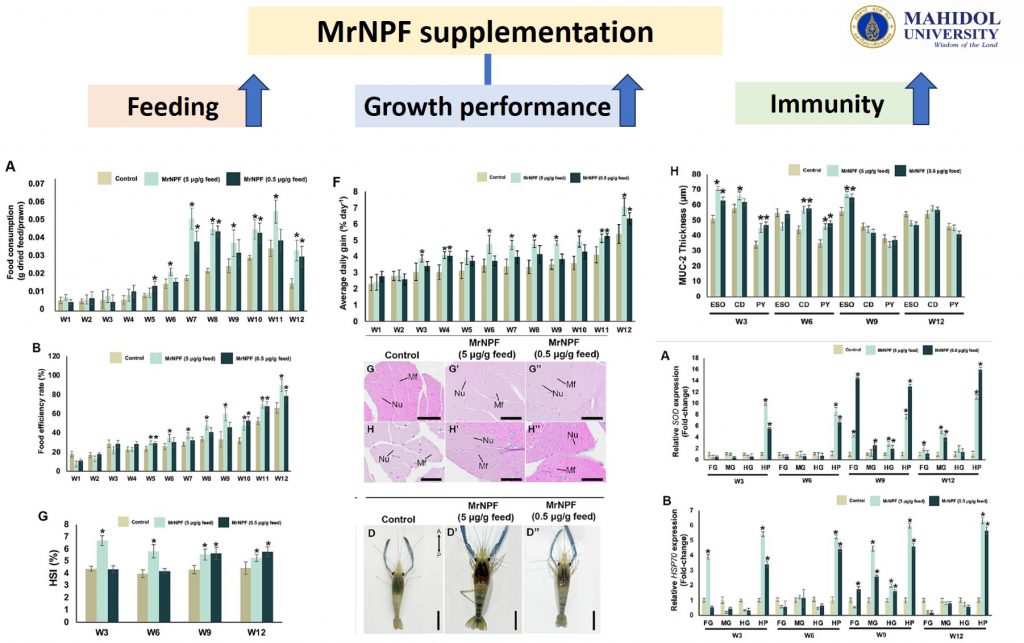
ในการศึกษาครั้งนี้ คณะผู้วิจัยได้ทำการศึกษาผลของการออกฤทธิ์ของนิวโรเปปไทด์เอฟ ต่อการกระตุ้นการกินอาหาร ประสิทธิภาพการย่อยอาหาร การเจริญเติบโต และระบบภูมิคุ้มกัน ในลูกกุ้งก้ามกรามระยะจูวิไนล์ (Macrobrachium rosenbergii NPF/MrNPF) คณะผู้วิจัยพบว่า การให้อาหารที่ผสมด้วย MrNPF ที่ระดับความเข้มข้น 0.5 และ 5 ไมโครกรัมต่อกรัมของอาหารสามารถกระตุ้นการกินอาหาร เพิ่มประสิทธิภาพการย่อยอาหาร โดยการเพิ่มดัชนีชี้วัดต่างๆ อาทิ food consumption, hepatosomatic index, และ feeding behaviors; และเพิ่ม digestive enzymes อาทิ amylase, protease, และ lipase activities รวมทั้งเปลี่ยนแปลงทาง histomorphology ของระบบทางเดินอาหาร เมื่อเปรียบเทียบกับกลุ่มควบคุม อย่างมีนัยสำคัญทางสถิติ (P < 0.05). นอกจากนี้ MrNPF สามารถกระตุ้นการเจริญเติบโต โดยการเพิ่มดัชนีชี้วัดที่ สำคัญ ได้แก่ mean weight gain (WG), specific growth rate, และ daily WG จากสัปดาห์ที่ 6 ถึง 12 เมื่อเปรียบเทียบกับกลุ่มควบคุม อย่างมีนัยสำคัญทางสถิติ (P < 0.05). อัตราการอยู่รอด (Survival rate) ทีแนวโน้มสูงกว่ากลุ่มควบคุม และสูงกว่าอย่างชัดเจนในสัปดาห์ที่ 9 (P < 0.05) นอกจากนี้ MrNPF เพิ่มการแสดงออกของ muscle growth-related genes อาทิ ยีน MrTOR, elF4B, LIM ตลอดจน immune ต่างๆ จากผลการวิจัยนี้ คณะผู้วิจัยได้ค้นพบองค์ความรู้พื้นฐานใหม่ที่สำคัญมาก ที่อาจจะสามารถนำ MrNPF มาประยุกต์ใช้โดยการผสมอาหารเพื่อเพิ่มอัตราการกินอาหาร การเจริญเติบโต ตลอดจนเพิ่มภูมิคุ้มกัน ในการเพาะเลี้ยงลูกกุ้งก้ามกรามต่อไปได้
ที่มาและความสำคัญ
Cultivation of freshwater prawn (Macrobrachium rosenbergii) has expanded considerably, thus emerging as a substantial contributor to Thailand’s aquaculture sector (New and Nair 2012; Tinikul et al., 2023; FAO, 2024). The global production of M. rosenbergii has increased significantly, reaching more than 300,000 tons. Meanwhile, demand has also grown significantly in both local and international markets. However, freshwater prawn farming also faces considerable obstacles, particularly disease outbreaks and hormonal imbalances in prawns caused by stressful situations, such as high-density culture, global warming, and overcrowded agricultural habitats (Hooper et al., 2023; Bhassu et al., 2024). These environmental stressors can lead to decreased feeding, nutritional deficiency, high mortality rate, and retarded growth, ultimately resulting in reduced productivity and significant economic losses (Pillai and Bonami, 2012; Kamaruding and Abdullah, 2021; Calado et al., 2022; Paul et al., 2025). Hence, feeding is a crucial behavior that ensures the intake of sufficient nutrients to maintain energy balance for these physiological processes (Celi et al., 2017). Feed constitutes the main expense in the aquaculture and ensures the quality, quantity, and good health of the prawns being raised (Yu et al., 2021). Thus, it is important to develop a suitable feed that optimizes feeding rates, promotes growth, and enhances immunity during the key developmental stages of this prawn. Neuropeptide F (NPF) is an important neuropeptide that potentially regulates feeding, foraging, metabolism, development, and reproduction, in insects and crustaceans (Fadda et al., 2019; Zhao et al., 2023). Considering the critical roles of NPF in regulating feeding, digestive enzyme activity, development and immunity in insects and crustaceans, we question whether M. rosenbergii NPF (MrNPF) could promote feeding, digestive functions, growth and immunity in juvenile prawns. This important knowledge of MrNPF supplementation may be developed as a viable feed additive in prawn aquaculture to improve feeding, growth performance, muscle mass, and health status of juvenile prawns, M. rosenbergii.
Abstract
Neuropeptide F (NPF) regulates feeding, growth, development, and reproduction in insects and crustaceans. In this study, we examined the effects of Macrobrachium rosenbergii NPF (MrNPF) on food intake, digestive functions, growth performance, and immunity in juvenile freshwater prawns (M. rosenbergii). Supplementing MrNPF at 5 and 0.5 μg/g of feed significantly stimulated food intake and digestive functions by enhancing food consumption, hepatosomatic index, and feeding behaviors; increasing digestive amylase, protease, and lipase activities; and improving gut histomorphology (P < 0.05). In addition, both doses of MrNPF-supplemented feed promoted growth performance by increasing mean weight gain (WG), specific growth rate, and daily WG from weeks 6 to 12 compared with the control groups (P < 0.05). Survival rate was significantly higher in the high-dose MrNPF group than in controls only at week 9 (P < 0.05). Furthermore, MrNPF supplementation significantly upregulated the expression of muscle growth-related genes, including MrTOR, elF4B, and LIM mRNA. Finally, MrNPF significantly enhanced the expression of immune-related genes. Collectively, our findings suggest that MrNPF is an essential neuropeptide that may serve as a potential regulator of feeding, growth, and immunity in juvenile M. rosenbergii. This knowledge could be used to enhance the aquaculture productivity of this crustacean species.
Keywords: Neuropeptide F, Feeding, Growth, Immune-related genes, Juvenile Macrobrachium rosenbergii, Aquaculture
Citation: Warinthip Vetkama, Thiraphon Deethaisong, Pannasa Manjit, Ruchanok Tinikul, Prasert Sobhon, Yotsawan Tinikul. 2026. Examination of the role of neuropeptide F in promoting food intake, digestive functioning, growth performance, and expression of immune-related genes in juvenile giant freshwater prawn, Macrobrachium rosenbergii, Aquaculture, Volume 614, 2026, 743587, https://doi.org/10.1016/j.aquaculture.2025.743587.
RELATED SDGs:
14. LIFE BELOW WATER
ผู้ให้ข้อมูล: รองศาสตราจารย์ ดร.ยสวันต์ ตินิกุล
ชื่ออาจารย์ที่ทำวิจัย: รองศาสตราจารย์ ดร.ยสวันต์ ตินิกุล
ชื่อนักศึกษาที่ทำวิจัย: นางสาววรินทิพย์ เวชกามา นางสาวทิราพร ดีไทยสง และนางสาวปัณณศา แม้นจิตร
แหล่งทุนวิจัย: 1. National Research Council of Thailand (NRCT-the Royal Golden Jubilee Ph.D. scholarship).
2. National Research Council of Thailand (NRCT) and Mahidol University (Mid-Career Research Grant)
3. NSRF via the Program Management Unit for Human Resources & Institutional Development, Research and Innovation
Credit ภาพถ่าย: รองศาสตราจารย์ ดร.ยสวันต์ ตินิกุล
Webmaster: ว่าที่ ร.อ. นเรศ จันทรังสิุกล